Add a site
Portland gets its own database. This is the one step that isn't instant, and its id is the value you'll use most.
This is the important one. A site is where Sarah's customers, bookings and invoices actually live, and its id is the value your app will send on every single request.
Locations → Provision location
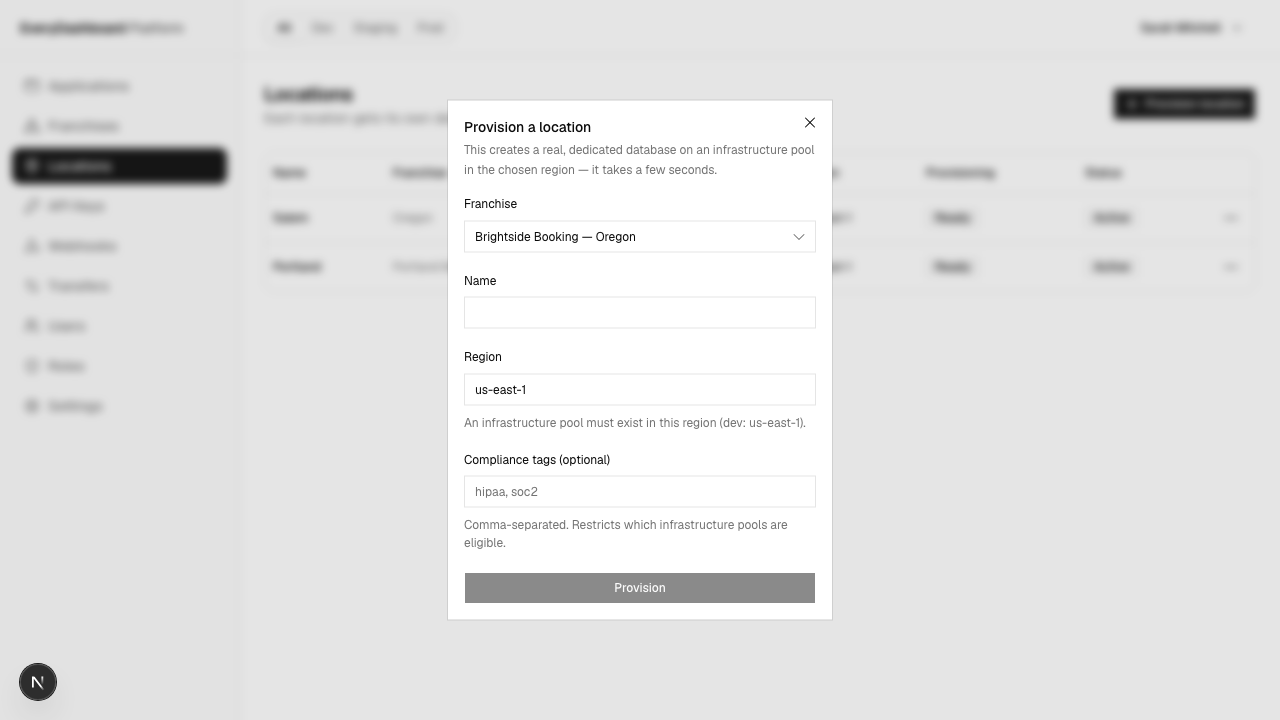
| Field | What to put |
|---|---|
| Franchise | Leave it: the site lands in the environment's default group. Pick one only if you've already made groups. |
| Name | Portland. |
| Region | Where the database lives. Pick the one nearest the people using it — that decides how fast the site feels for staff and customers, not for your servers. |
| Compliance | Optional tags, narrowing which hosts are eligible. |
Wait for Ready
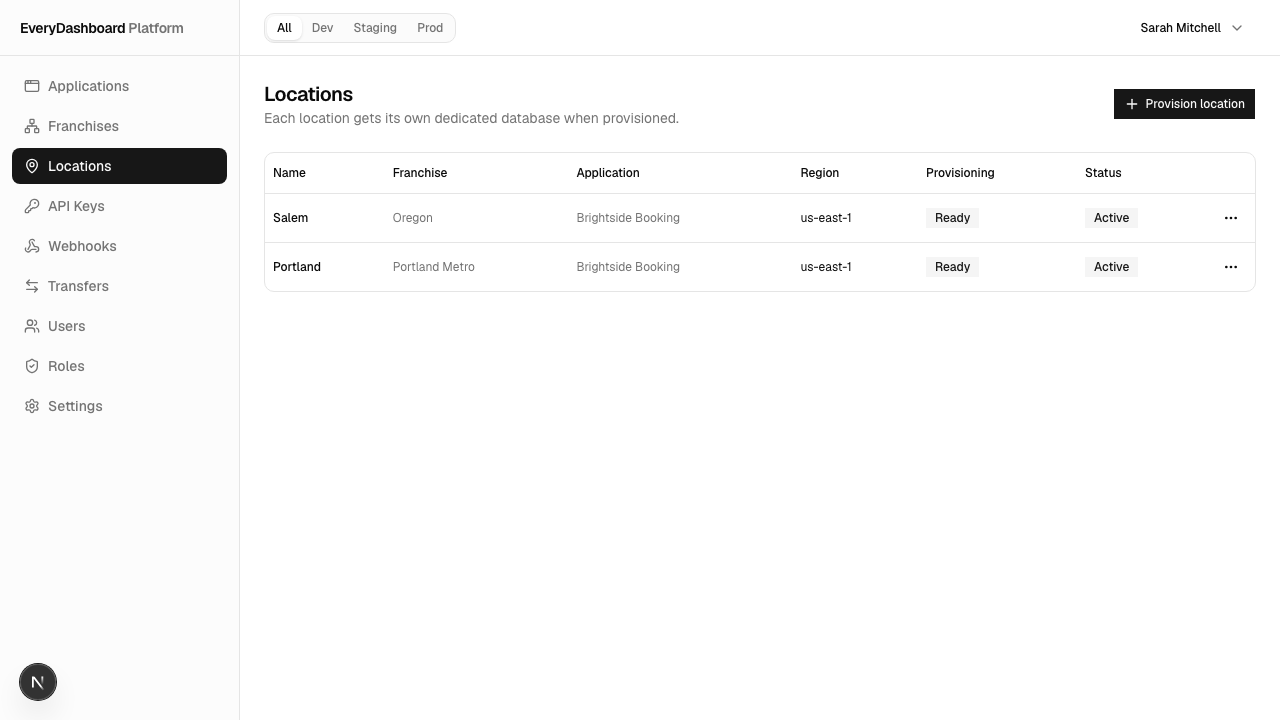
A database has to be built, so a new site is briefly not usable. It's usually seconds.
Requests to a site that isn't ready come back 503, which means wait, not give up —
see When things go wrong. If it stays
stuck rather than reaching Ready, that's a failure to look into rather than wait out.
Copy the id
Each row has a copy action for the site's id. Store it now — it goes in the
X-Location-Id header on every request about customers, bookings or invoices, and
it's the single most-used value in your integration.
export HYPHABASE_LOCATION_ID="e42da81b-33a3-4f86-813e-5ec6cd80bea7"For one site, this lives in your config. For several, you'll usually keep them in your own database alongside whatever you call that site.
About compliance tags
Passing a tag restricts provisioning to hosts marked as having that capability.
Compliance tags choose a host. They don't make you compliant.
It does not itself make your deployment compliant with anything, and it's no substitute for legal advice. Read it as "put this database somewhere suitable", not "this is now certified".
If nothing matches your region and tags together, provisioning fails rather than quietly putting the data somewhere unsuitable.
What you've got now
An empty Portland with its own database, ready for customers — and unreachable by any key until you say otherwise. That's the next step, and it's the one everybody forgets.